Remodeling · August 28, 2026 · 12 min read
Home Addition vs Moving in Tennessee
If you locked a sub-5% mortgage, adding on is usually the stronger 2026 move. Here's the math against selling and buying at today's rates.
If you've outgrown your house in Cookeville or anywhere across the Upper Cumberland, you're facing a decision that thousands of Middle Tennessee homeowners wrestle with every year: do you add on to the home you already own, or sell and buy something bigger? With mortgage rates sitting near 6.7% and housing inventory still tight across the local market, this choice has real financial stakes, and the answer isn't the same for everyone.
The single biggest factor? Your current mortgage rate. If you locked in at 4% to 5% a few years ago, walking away from that rate to finance a new home at today's prices can cost you tens of thousands of dollars over the life of your loan, on top of the transaction costs of selling and buying. But that doesn't mean adding on is always the right call.
We're S&T Construction, a family-owned custom home builder and remodeler based in Cookeville, TN. We've been building and remodeling across the Upper Cumberland since 2017, and we've walked plenty of families through this exact decision. Here's an honest breakdown of both paths, with real numbers, not generic filler.
The short answer: For most Upper Cumberland families in 2026 who already hold a mortgage rate below 5%, adding on is the stronger financial move. A well-planned 500 sq ft home addition typically runs $87,500 to $162,500 in Middle Tennessee, while the combined cost of selling, buying, and absorbing a higher mortgage rate on a comparable upgrade can easily exceed $45,000 in transaction fees alone, before you account for hundreds of dollars more per month in mortgage payments for the next 15 to 30 years. But if your property has structural limitations, you need a dramatically different location, or your current rate is already high, moving may genuinely make more sense.
If the other fork in the road is buying existing versus building new, our buy-or-build cost comparison walks through that decision with 2026 numbers.
What Is Adding On to Your Current Home?
A home addition means expanding your existing home's footprint: building new square footage onto or above the existing structure. This could be a single-story addition for a new bedroom, a primary suite with a new bathroom, a bonus room, or even a second-story addition.
Key advantages:
-
You keep your current mortgage rate, which in 2026 can save thousands annually compared to refinancing or buying at 6.65% to 6.78% (national average).
-
You stay in your neighborhood, school zone, and community.
-
You get exactly the space you design, with no compromises on layout, finish level, or materials.
-
You skip the hassle of selling, packing, and relocating your family.
What Is Selling and Buying or Building Bigger?
This path means listing your current property, finding a larger home (or building new), and financing the purchase at today's rates. It's trading one house for another.
Potential benefits:
-
Instant access to more living space, with no months of construction disruption.
-
Opportunity for a completely different layout, floor plan, or lot.
-
Different location: better commute, new neighborhood, more land.
-
No integration challenges with older homes or an existing structure that may have hidden issues.
Home Addition vs Moving: How They Compare at a Glance
| Factor | Adding On | Selling & Buying Bigger |
|---|---|---|
| Best for | Homeowners who love their location and hold a low mortgage rate | Those who need a dramatically different home, lot, or area |
| Total cost (500 sq ft example) | $87,500–$162,500 (mid to higher-end finishes) | $25,000–$40,000 in transaction costs + new mortgage at ~6.65%–6.78% (national average) |
| Cost per square foot | $175–$325/sq ft (Middle Tennessee) | N/A. You're buying an entire property |
| Timeline | 4–8 weeks design/permits + 3–6 months construction | 2–4 months selling/buying + moving + possible renovations |
| Mortgage impact | Keep existing rate | New rate at ~6.65%–6.78% (30-year fixed, national average, late August 2026) |
| Disruption | Construction noise and dust for several months | Stress of selling, moving, double payments, settling in |
The headline takeaway: adding on costs more upfront for the new space, but moving costs more over time once you factor in today's mortgage rates and transaction fees.
Total Financial Impact
This is the factor that decides it for most families, and it's where the numbers get eye-opening.
Home additions in Nashville and Middle Tennessee often average $175 to $325 per square foot. The average cost for a home addition in Tennessee ranges from $120 to $350 per square foot, depending on the addition type, complexity, and finish level. Typical full home additions in Tennessee have a total cost of about $90,000 to $180,000. A typical 600 square foot addition costs between $70,000 and $190,000.
Now compare that to moving. If you sell a $400,000 house, you're looking at roughly $24,000 in realtor commissions (6%), $4,000 to $8,000 in closing costs, plus moving expenses and inspections, a cost split that easily totals $30,000 to $40,000 before you've even unlocked the door of your next home. Then comes the real hit: financing a $500,000 replacement home at today's national average 30-year fixed rate of approximately 6.65%–6.78% instead of your existing 4.75% rate can add several hundred dollars to your monthly payment. Over seven years, that rate differential alone can amount to $30,000 to $50,000 in additional interest paid.
Home addition costs in Middle Tennessee can reach $500 per square foot for luxury-level projects with higher-end finishes, custom cabinetry, and premium materials, but most projects land well below that. Home additions in Tennessee cost $120–$320 per square foot for the vast majority of standard to mid-range work.
Winner: Adding On. The upfront investment is significant, but the total financial impact over 5 to 10 years is almost always lower than moving, especially when you're protecting a sub-5% mortgage rate. The trade-off: moving gives you instant access to finished space without months of construction.
Timeline and Life Disruption
Neither path is disruption-free, but the disruptions are very different.
For a home addition, expect 4 to 8 weeks for design and the building permit process, followed by 3 to 6 months of construction for most projects. Permit approval typically takes 2–4 weeks for standard additions in the Cookeville area. Larger additions or second-story additions requiring structural engineering review can extend permitting. All home additions in Tennessee require building permits, and additions often need separate electrical, plumbing, and mechanical permits. Permit fees for home additions range from $800 to $2,500 depending on the scope. Cookeville's permit office enforces the 2018 International Building and Residential Codes, with inspections required at each construction stage: foundation, framing, roofing, rough-in for electrical/plumbing/mechanical, insulation, and final.
During construction, you'll deal with noise, dust, and workers on-site. But you're sleeping in your own bed, your kids stay in their school, and life continues around the project.
Moving, by contrast, involves listing your home, showings, negotiations, inspections, appraisals, closing, then doing it all again on the purchase side. The timeline can stretch 2 to 4 months or longer in a tight market. You may face double mortgage payments, temporary housing, or the stress of coordinating two closings. And once you move in, many buyers discover the "bigger" house still needs kitchen or bathroom work to match their preferences.
Winner: Adding On (narrowly). Construction disruption is real and lasts months, but it's predictable and manageable with a good schedule and clear communication. Moving disruption is shorter but more chaotic and stressful, with more variables outside your control.
Market Conditions and Mortgage Rates
This is where 2026 Tennessee realities make the strongest case for staying put.
As of late August 2026, the national average 30-year fixed mortgage rate sits at approximately 6.65%–6.78%, with 15-year fixed rates around 5.95%–5.96%. If you purchased your home between 2019 and 2022, you likely locked in a rate between 3% and 5%. That rate is a financial asset, one you forfeit the moment you sell.
Consider a concrete example: a family with a $300,000 balance at 4.75% pays roughly $1,565/month in principal and interest. Moving to a $500,000 home financed at 6.65%–6.78% with 20% down results in payments around $2,610/month. That's over $1,000 more per month ($12,500+ per year), going largely toward interest rather than building equity. Most lenders allow borrowing up to 80–90% of home value, and homeowners can use a HELOC for financing additions, allowing them to tap existing home equity without losing their primary mortgage rate. Home equity loans allow borrowing against existing home equity, and cash-out refinancing replaces your mortgage with a larger one, though that means giving up your low rate. Construction loans are short-term financing for large projects and can be a smart option for larger additions.
The Upper Cumberland housing inventory remains competitive. Finding a same-size or larger home in the Cookeville area at a reasonable price isn't guaranteed, and bidding above asking price remains common in desirable neighborhoods. East Tennessee custom builders who already know county permitting and lot conditions can also keep an addition on schedule when the alternative is hunting for inventory that isn't there.
Winner: Adding On. In 2026's rate environment, the mortgage math overwhelmingly favors keeping your current loan. The trade-off: if your current rate is already near 6.5% or higher, this advantage disappears, and moving becomes a more level comparison.
Customization and Control Over Results
When you add on, you're designing exactly the space your family needs. Want a primary suite with a walk-in closet and tiled shower? A bonus room with built-in shelving? An accessible in-law suite with separate utilities and a kitchenette? You choose the layout, the materials, the flooring, the roofing integration. Every detail.
With buying, you're compromising. Existing homes rarely match your wish list perfectly, and post-purchase renovations add cost and delay. Even new construction from a production builder limits your customization compared to a custom-built addition designed specifically for your property and lifestyle.
Complex designs increase home addition costs significantly, and the finish level is the single biggest variable beyond size. Standard finishes keep costs toward the lower end of the square foot range, while higher-end finishes with custom cabinetry, premium tile, and upgraded windows can push costs toward or past $300 per square foot. The average expenses for interior finishes can range from 20% to 30% of the total budget. Architectural and engineering fees usually account for 5% to 15% of the total project cost. But you're getting exactly what you designed. No surprises, no settling.
At S&T Construction, this is where our process matters. We provide detailed cost breakdowns, frequent updates throughout the project, and transparent communication from design through final inspection. When you're building onto your existing home, quality control and integration with the existing structure are critical: matching rooflines, siding, and interior finishes so the addition feels like it was always part of the house.
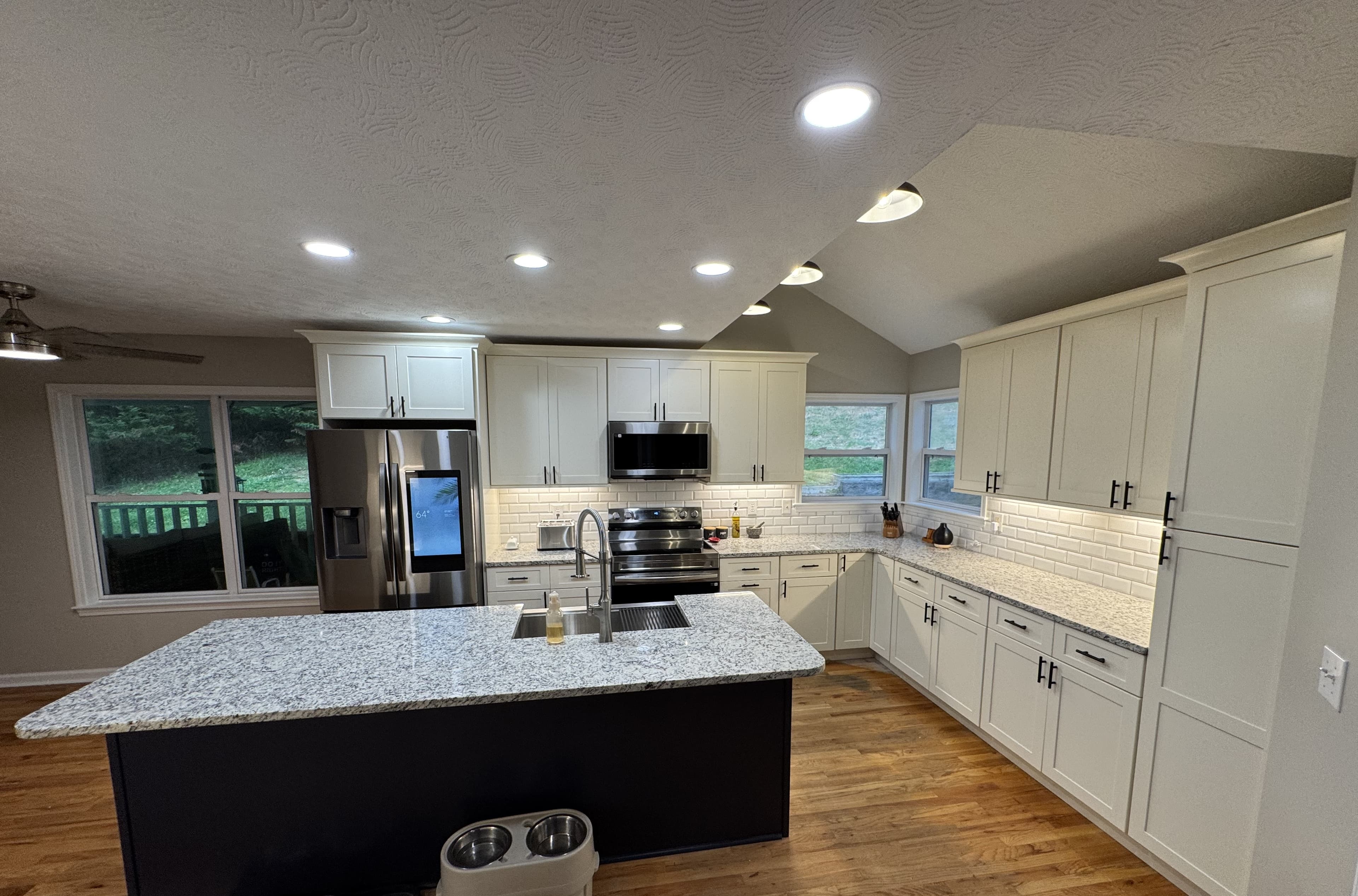
Winner: Adding On. You get precisely the space you need, designed around your family and your property. The trade-off: buying an existing home gives you a finished product on day one, and you avoid the challenge of integrating new construction with older homes.
Home Addition vs Moving: Which Should You Choose?
Choose adding on if:
- You love your neighborhood, schools, and community
- You hold a mortgage rate meaningfully below current rates (under 5.5%)
- You need specific space solutions: a bedroom, primary suite, family room, or accessible suite
- You want full control over design, materials, and finish level
- The additional square footage you need is modest (one to three rooms)
Choose moving if:
- Your property has structural limitations (lot setbacks, foundation constraints, septic or utility issues that prevent expansion)
- You need a completely different location, school district, or commute
- Your current home requires major repairs (roof, foundation, HVAC) that would stack on top of addition costs
- Your current mortgage rate isn't significantly lower than today's rates
- You need substantially more space than an addition can practically deliver (1,500+ sq ft)
For most Upper Cumberland families in 2026, an addition makes sense, financially and practically. The combination of protected mortgage rates, avoided transaction costs, and the ability to design exactly what you need makes building onto your existing home the stronger path for most homeowners who are happy with their location.
If you're weighing this decision, we offer free estimates with honest, detailed cost breakdowns. No pressure, no generic numbers, just real figures based on your home, your property, and what you actually need built.
Frequently Asked Questions
How much does a typical bedroom addition cost in Tennessee?
Basic bedroom or office additions typically range from $175 to $225 per square foot in the Cookeville and Upper Cumberland area. For a 250 to 400 sq ft bedroom addition with standard finishes, expect roughly $44,000 to $90,000. That includes new foundation, framing, roofing tie-in, insulation, electrical, flooring, and interior finishes. Adding a closet system or upgraded materials pushes toward the higher end.
What about adding a primary suite with bathroom?
A full primary suite with a new bathroom runs higher because of new plumbing, tile, fixtures, and ventilation. Adding a bathroom can increase costs by $8,000 to $18,000 beyond the base room addition cost. Single-room additions range from $225 to $325 per square foot. For a 500 sq ft primary suite with ensuite bath and mid-range finishes, budget $120,000 to $160,000 in the Upper Cumberland area. Mother-in-law suites cost $250 to $400 per square foot due to the additional plumbing, kitchenette, and accessibility requirements involved.
How do moving costs compare to addition costs?
On a $400,000 home sale, expect approximately $24,000 in realtor commissions, $4,000–$8,000 in closing costs, $3,000–$5,000 in inspections and moving expenses, totaling $31,000 to $37,000 before you purchase your next home. Then add the cost of buying: another round of closing costs, inspections, and appraisal fees on the purchase side. The mortgage rate impact adds cost every single month for the life of your new loan. Total five-year cost of moving often exceeds $70,000 to $100,000 when you include the rate differential, significantly more than many room addition projects.
When does moving actually make more sense?
Moving genuinely makes more sense when your current home has serious structural or mechanical problems that would need addressing regardless of an addition: a failing foundation, aging roof, or outdated HVAC system that would add cost on top of the addition. It also makes sense when your lot physically can't accommodate the new square footage you need (setback rules, slope, septic placement), when you need a fundamentally different location, or when your current mortgage rate is already close to today's rates so you're not giving up a financial advantage. Site conditions can add $10,000 to $30,000 to costs in areas with Tennessee's clay or karst topography, which can make some properties impractical for expansion.
How long do home additions take in the Upper Cumberland area?
Plan for 4 to 8 weeks of design and permitting, followed by 3 to 6 months of construction for most home additions. Bump-out additions and smaller projects may finish faster, while second-story additions or complex designs with structural engineering requirements can take longer. Permits and inspections vary by local municipality in Tennessee, but Cookeville's process is generally consistent. Expect 2 to 4 weeks for standard permit approval. At S&T Construction, we build detailed project schedules and keep clients updated throughout every phase so there are no surprises on timeline or cost.
Can you add on to any type of home?
Most homes can accommodate some form of addition, but not every home can support every type. An existing single-story home on a slab foundation may require different structural approaches than one with a crawl space or basement. Second-story additions require evaluation of the existing foundation and framing to confirm they can handle the additional load. This is where structural engineering comes in. Lot constraints like setback requirements, steep terrain, and utility or septic locations can limit where an addition can go, especially on rural Upper Cumberland properties. Older homes may also present challenges with matching exterior materials and integrating new construction with existing lines. Location significantly affects contractor labor rates in Tennessee, and skilled trades availability in smaller markets can affect scheduling. We assess all of this during our initial consultation and give you an honest answer about what's feasible before any commitments are made.
Ready to find out what adding on would actually cost for your home? Contact S&T Construction for a free estimate: real numbers based on your property, your goals, and Upper Cumberland pricing. No obligation, no guesswork.
S&T Construction is a family-owned custom home builder and remodeler serving Cookeville and the Upper Cumberland since 2017. Request a free estimate.